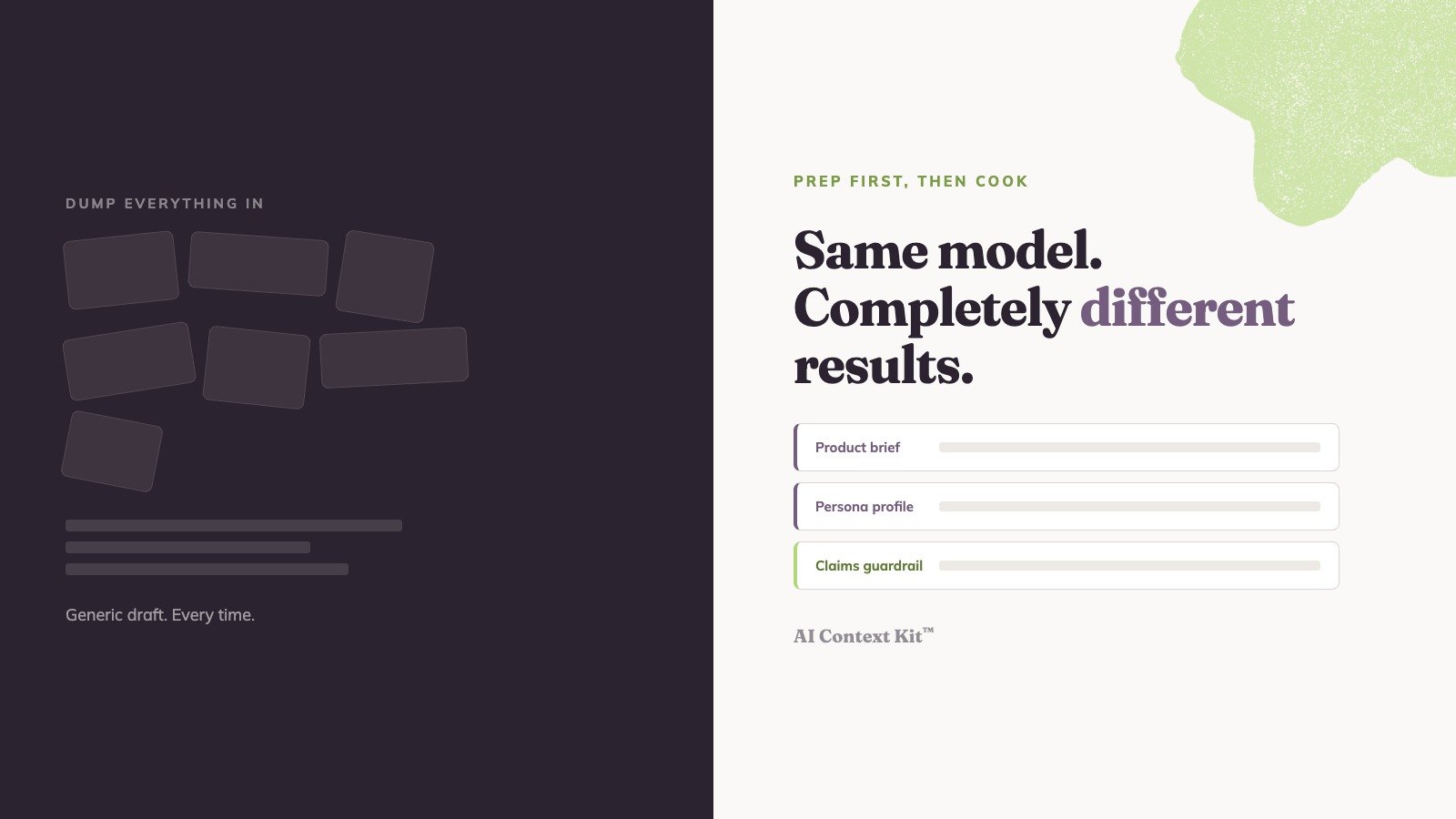

Most AI outputs feel flat because the input is flat.
You give AI a prompt. AI gives you a generic draft. You rewrite it. You wonder why you bothered.
The problem isn’t the model. It’s that the model doesn’t know your product, your buyers, or how your market actually works. It’s working with the same surface-level information it scraped from a thousand other companies.
It sounds fine at first glance, but it usually misses the buyer’s actual priorities, blurs important distinctions between audiences, overstates claims, and falls back on cliché language.
When you feed AI real context — detailed documentation about your product, your buyers, their pain points, their objections, how decisions actually get made — the output changes completely.
I’ve pulled together 92 specific things marketers can do with AI once that context exists. Concrete use cases across 11 marketing functions, each with a prompt to try.
The documentation doesn’t just help humans align. It gives AI enough grounding to produce sharper, more accurate, more relevant outputs across a much wider range of work.
→Marketing use cases
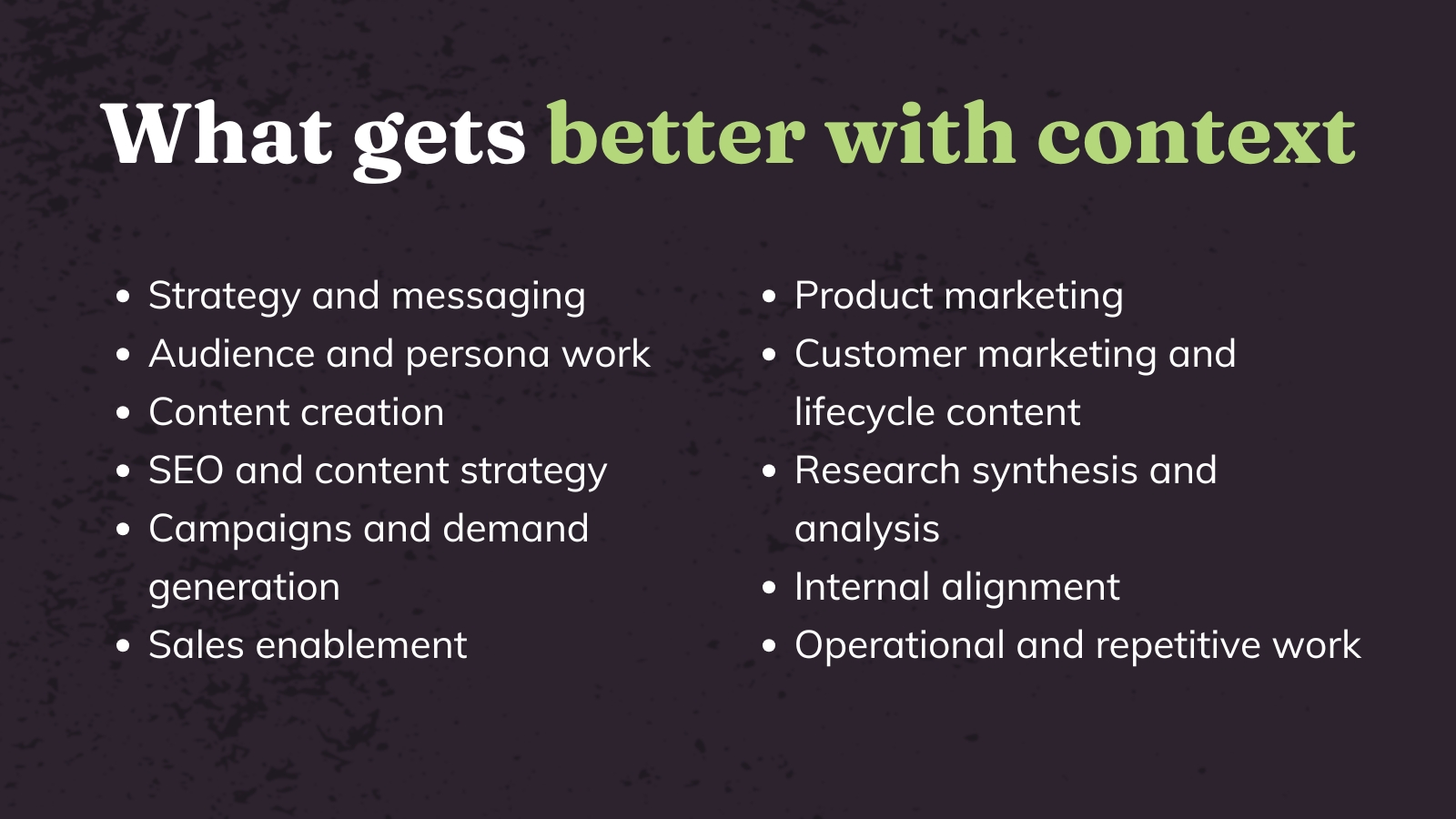
From positioning and messaging frameworks to nurture sequences to sales battlecards, here’s what AI can help with when it actually knows your product and your buyers.
→1/ Strategy and messaging
- Develop positioning
- Create messaging frameworks
- Define value propositions
- Build message hierarchies
- Map features to benefits
- Tailor messaging by audience
- Refine "why change / why now / why us"
- Create language guidelines
- Standardize terminology
- Identify weak or inconsistent claims
Using the product brief and persona profiles, draft three value proposition statements for [persona name]. Each should lead with a different problem from their pain points list.→2/ Audience and persona work
- Generate persona-specific messaging
- Adapt the same story for buyers, users, influencers, and evaluators
- Surface likely objections by audience
- Identify what each stakeholder actually cares about
- Create audience-specific pain point summaries
- Map jobs to be done, motivations, barriers, and desired outcomes
- Highlight conflicts between what buyers want and what end users want
Using the persona profiles, compare what the decision-maker cares about versus what the end user cares about. Where do their priorities conflict, and how should our messaging handle that?→3/ Content creation
- Write product, feature, and use-case pages
- Build landing pages
- Write blogs, articles, and thought leadership drafts
- Generate FAQs
- Build solution briefs and one-pagers
- Create eBooks, guides, and checklists
- Turn one asset into many smaller assets
Using the product brief, write a use-case page for [specific use case]. Write it for [persona name] and focus on the workflow problem it solves and what changes for them after implementation.→4/ SEO and content strategy
- Generate topic clusters
- Create keyword-informed content outlines
- Identify content gaps
- Build glossary pages
- Create pillar content
- Produce educational articles tied to search intent
- Create internal linking recommendations
- Map content to funnel stages
Using the terminology glossary and product brief, build a glossary page with definitions for the 15 terms our buyers are most likely to search for. Write each definition so it answers the query directly and naturally references our product category.→5/ Campaigns and demand generation
- Write email nurtures
- Generate ad copy
- Build campaign themes
- Create audience-specific campaign variants
- Develop webinar topics
- Draft event follow-up content
- Create retargeting copy
- Build CTA variants
- Create nurture paths by persona or funnel stage
Using the [persona name] profile, write a 3-email nurture sequence. Email 1 should lead with their biggest pain point. Email 2 should introduce how the product addresses it. Email 3 should include a proof point and a CTA to book a demo.→6/ Sales enablement
- Create discovery questions
- Draft sales talk tracks
- Build objection-handling frameworks
- Produce follow-up emails
- Generate account-specific messaging
- Write call prep briefs
- Create battlecards
- Build competitor comparison drafts
- Summarize what matters to each stakeholder in a buying group
- Turn product details into sales-ready language
Using the product brief and persona profiles, build an objection-handling guide for the top five objections listed in the [persona name] buying behavior section. For each, include a short response and the proof point or feature that supports it.→7/ Product marketing
- Create launch messaging
- Draft release announcements
- Build feature narratives
- Create internal enablement materials
- Generate packaging for new capabilities
- Draft comparison pages
- Map proof points to use cases
- Build implementation or adoption messaging
- Create customer-facing explanations of product changes
We just shipped [new feature]. Using the product brief, draft a release announcement that explains what it does, which persona it matters most to, and what problem it solves. Keep it under 200 words.→8/ Customer marketing and lifecycle content
- Create onboarding content
- Write adoption emails
- Generate training summaries
- Produce customer newsletters
- Create expansion messaging
- Build renewal value recaps
- Draft executive business review content
- Create best-practice communications
- Tailor post-sale messaging by role
Using the product brief and the [persona name] profile, write a 90-day check-in email that reinforces the value they should be seeing by now and introduces one feature they may not be using yet.→9/ Research synthesis and analysis
- Summarize patterns across interviews, briefs, persona docs, and notes
- Identify recurring pain points
- Find messaging gaps
- Spot contradictions
- Organize customer language into themes
- Compare how different segments talk about the same problem
- Surface missing proof points
- Show where current messaging is too generic or too product-led
Here are notes from five recent customer interviews. Using the persona profiles as a reference, identify which pain points came up most often, any new ones not in the profiles, and where our current messaging misses what customers actually said.→10/ Internal alignment
- Create shared summaries for sales, product, customer success, and leadership
- Translate product language into market language
- Create internal FAQs
- Draft training materials for teams
- Build source-of-truth documents
- Check drafts against approved positioning
- Create reusable prompt libraries for the company
Using the product brief, create a one-page internal summary that a new marketing hire could read on day one to understand what the product does, who it's for, and how we talk about it.→11/ Operational and repetitive work
- Repurpose content faster
- Localize tone by audience
- Create first drafts more quickly
- Review writing for consistency
- Adapt existing copy for new channels
- Reduce blank-page work
- Speed up revision cycles
- Make more outputs from the same source material without starting over every time
Here's a blog post we wrote for [persona A]. Using the [persona B] profile, adapt it for that audience. Change the framing, examples, and CTA to match what they care about.→What gets better when the context is good
When the input documentation is strong, marketers can usually expect higher quality outputs in a few specific ways.
AI becomes more accurate, more audience-aware, more differentiated. It stays consistent, holds nuance, and produces work that sounds like it came from a real company instead of a content machine. It’s less likely to make unsupported claims. And the same product story adapts better across audiences.
In practice, that means:
- Fewer revisions
- Less generic copy
- More credible messaging
- Faster draft creation
- Better persona fit
- Better reuse of institutional knowledge
- More consistency across channels and teams
- Cleaner handoffs between departments
- Faster ramp-up for new team members
- Fewer conflicting narratives across teams
And the benefits are not limited to marketing. Once a company has strong product and customer documentation, AI becomes useful across almost every customer-facing and operational team, because AI now has shared context about what the product is, who it serves, what problems it solves, how buyers think, what users struggle with, and which claims are actually true.
→Why this works
AI quality depends heavily on the quality of the context it receives.
When marketers document their product and customers well, they are giving AI the actual problem being solved, the actual audience, the actual vocabulary, the actual differentiators, the actual objections, the actual proof points, the actual buying dynamics, and the actual jobs users are trying to get done.
That changes AI from a generic text generator into something more like a teammate who actually knows your business.

→The caveat
Good documentation improves AI a lot, but it does not eliminate the need for judgment.
Marketers should still review for:
- Unsupported claims
- Overconfident language
- Legal or regulatory risk
- Poor strategic choices
- Missing market context
- Weak prioritization
- Bad assumptions hidden inside polished copy
→Building your AI Context Kit™
Everything on this list gets easier once the right context exists. And yet, a lot of marketing teams skip that step. Either because they don’t have the time or they don’t know how. They go straight to prompting and wonder why AI outputs feel generic. The problem isn’t the AI. It’s the input.
That’s why I created The AI Context Kit™.
Your product experts carry deep, nuanced knowledge about how your product works, who it serves, what buyers struggle with, and why deals close or stall. That knowledge is locked in sales calls, demo recordings, and people’s heads.
The AI Context Kit™ gets it out, structures it, and gives you documents that turn AI from a generic text generator into a tool you can use across your entire go-to-market.
One interview. About one day of your team’s time. First drafts in five business days, and the full kit in 2–3 weeks.
And once you have it, everything on this list becomes a real prompt instead of a hypothetical one. Load the documents into Claude, ChatGPT, Copilot, or any AI tool as project context, and the difference in output quality is immediate.