
The dominant narrative right now is that AI output is generic because the prompt isn’t good enough. The fix you keep hearing is better prompts. Prompt courses, prompt libraries, prompt frameworks, prompt certifications.
When AI doesn’t know your product, no prompt fixes that. You can ask three different ways and get three versions of the same generic SaaS-speak, because the model is filling in blanks with category averages. It doesn’t know what your product actually does, who actually buys it, what they care about, how your buyer talks, or your unique point of view. So it makes that up. Plausibly.
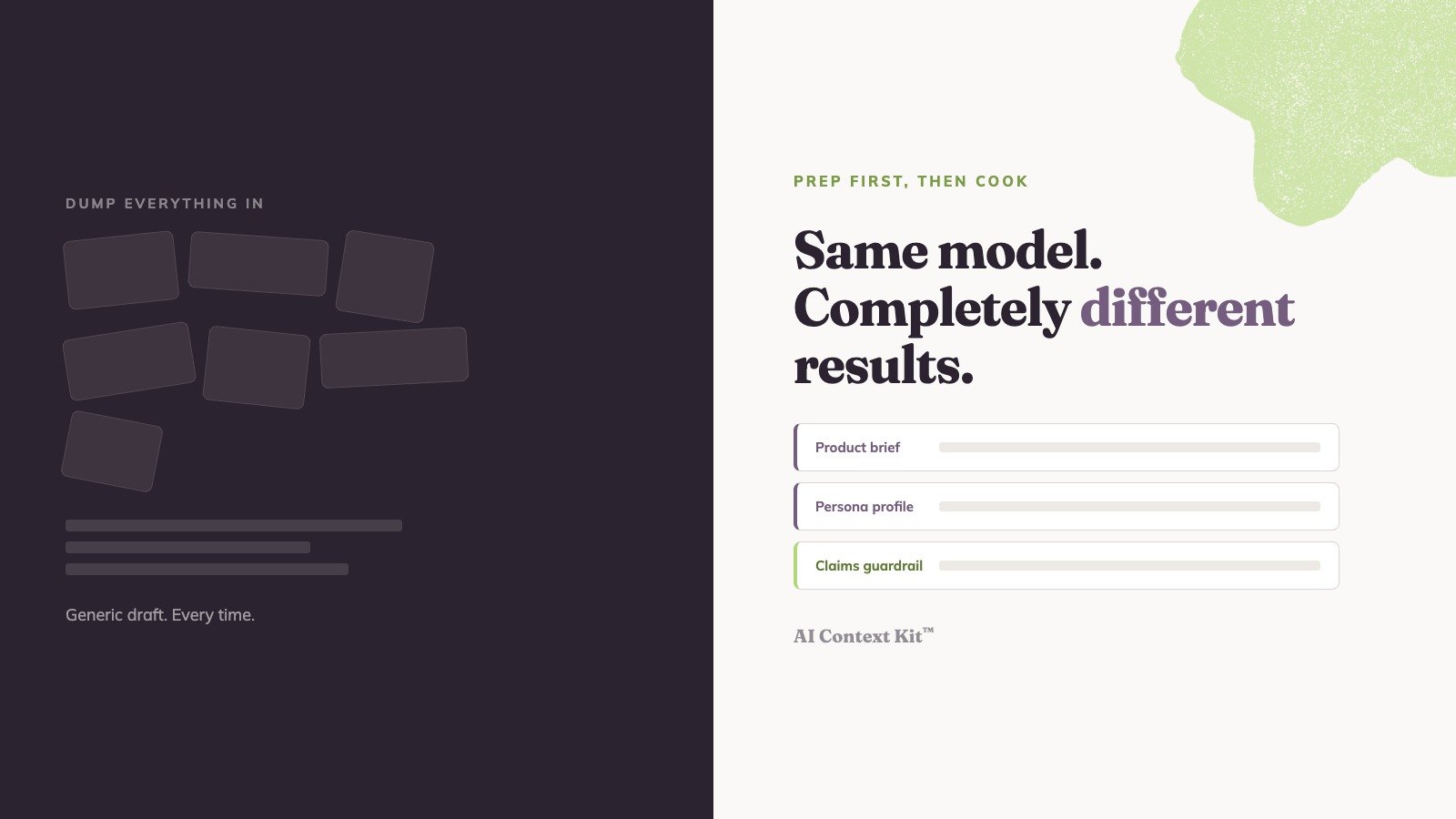
The fix is giving AI tools real context. Documented product knowledge. Documented buyer personas. Structured for AI to read.
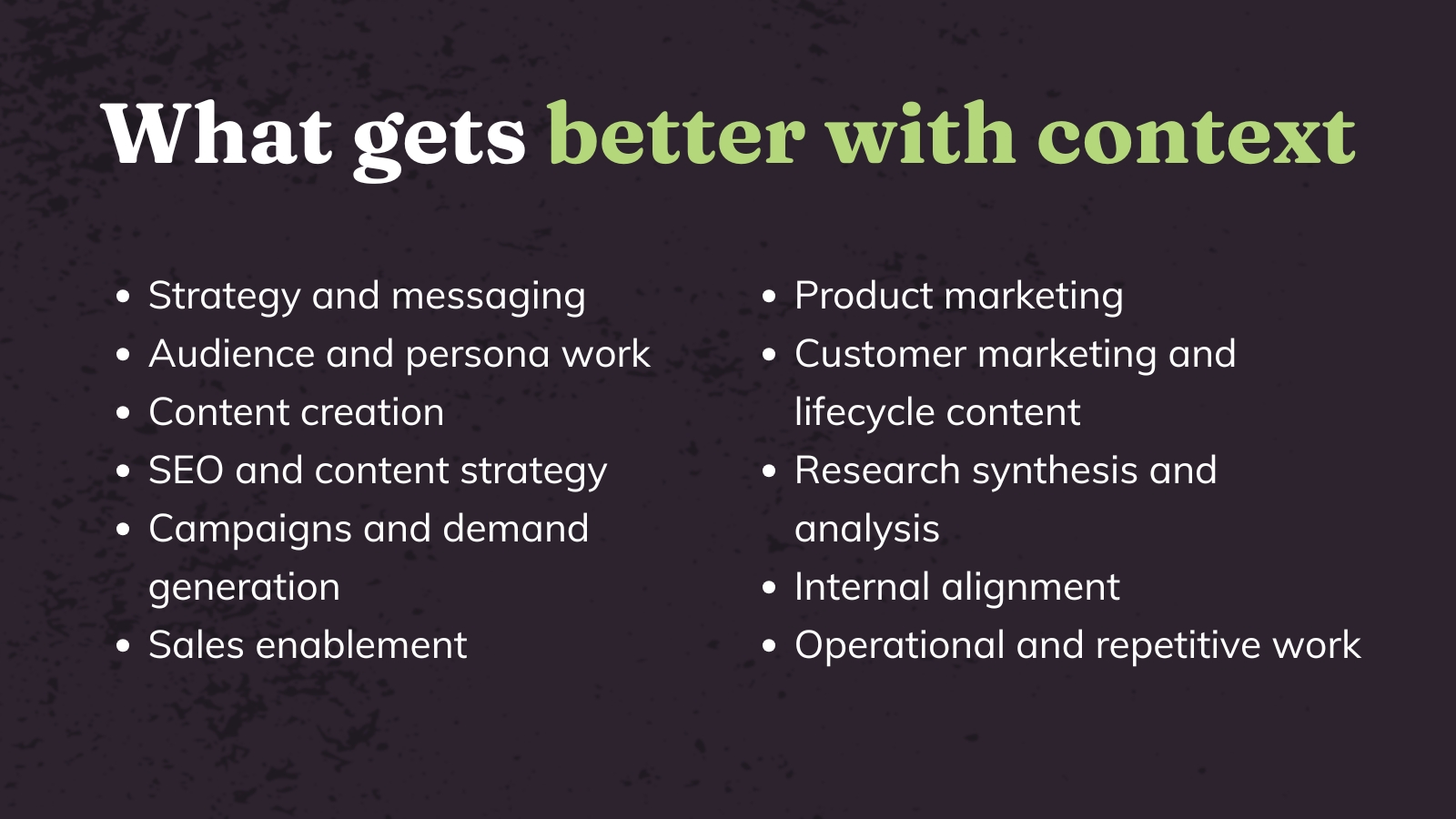
Once that exists, everything downstream gets better. Not just copy. Strategy work, sales enablement, new hire onboarding, persona-specific campaigns, AI search content at volume, cross-functional alignment. All of it.
→What I walked through at the PMA session
Last month, I presented to a group of product marketers at the Product Marketing Alliance’s AI for PMMs monthly meetup on exactly how I’m helping companies fix the context problem.
I walked them through my entire process for the AI Context Kit™: the interview guide I use with product experts, the prompts that turn the transcript into a tagged source document, how I turn that source into a comprehensive product brief and persona profiles, and how the final markdown files get loaded into AI as project context so the whole team can work from them.
The example I used was adapted from a recent engagement. My client had four products, only one of which was well-documented. The other three were not. I sat down with their product owner for a two-hour interview, ran the process I just described, and delivered a comprehensive product brief plus four persona profiles. The client reviewed everything and came back with minimal edits, because it was created directly from what the expert actually said.
As I walked through my process and shared the example, there were a few learnings that stood out from the session worth pulling out for everyone who wasn’t there.
→1/ The persona they’d been writing to wasn’t actually the buyer
The most interesting moment from the product expert interview wasn’t a feature or a value prop. It was a positioning correction nobody had been looking for.
The website had been written to a manager-level champion for years. That approach worked for their other products. Just not this one.
The interview surfaced something the marketing team hadn’t considered about this particular product: it makes that manager’s job harder. It’s a compliance tool. It removes shortcuts the manager’s team had been quietly relying on. It documents non-compliance. The manager isn’t the buyer, and they are not really the natural champion either. The buyer sits one level up. The person whose neck is on the line if compliance fails. The manager is closer to a reluctant user.
That changes how the web copy should read. Probably the campaigns and the sales collateral too.
You wouldn’t catch this from the website. You wouldn’t catch it from the brochure. Sales might or might not surface it depending on who they’re talking to and what comes up in those conversations. But you catch it reliably when you sit a product expert down, ask the right questions in the right order, and take the time to organize what they said.
That kind of insight is hard to put a number on, and it tends to be worth more than the documentation itself.
→2/ The experts actually enjoyed it
A common question in the Q&A was how to get product, sales, and engineering to give you their time.
The honest answer is that the resistance most marketers expect mostly doesn’t materialize. At least not when the product is technical and the marketing has historically been shallow.
Technical experts get frustrated when marketing doesn’t understand the product. They’ve watched the website launch with vague claims. They’ve watched campaigns go live aimed at the wrong buyer. They’ve watched a feature get described in the deck using language that doesn’t match how anyone actually uses it. They have opinions. They want to be asked.
The product owner from this engagement told me how much she enjoyed the process. It was a break from her day, and it was a chance to talk about the product she’d worked so hard to build.
Most marketing teams don’t have a repeatable way to extract and document this knowledge, so they keep relying on the same experts to answer the same questions over and over.
In this case, it had a second effect: the product was just never a marketing priority, because there was no easy way to write about it. Once the documentation existed, that changed. Marketing could produce higher quality materials faster, without pulling an expert in every time.
→3/ What good context unlocks
A common misconception about this work, documenting product knowledge and buyer personas so AI can use it, is that it’s mostly for producing better copy. Copy is part of it, but it undersells what’s actually possible.
- Persona-specific campaigns that actually sound like the persona.
- Sales enablement grounded in documented product reality.
- New hires producing usable work in week 4 instead of month 3.
- AI search content at the volume that channel demands, with real product depth in every page.
- Cross-functional alignment because every team is working from the same product truth.
- Knowledge that doesn't walk out the door when an expert leaves.
The AI Context Kit™, the product brief, the persona profiles, the markdown files, isn’t a copywriting tool. It’s infrastructure. It improves everything downstream.
→What to do with this
You can keep blaming the prompt. Keep buying prompt courses, prompt libraries, prompt frameworks. Keep telling your team they just need better prompts.
Or you can fix the input.
The teams that figure this out first will spend the next two years producing work that’s noticeably better, faster, and more consistent than teams still iterating on prompts. Not because they have better tools. Because they have better source material.
If you want to talk through what this looks like for your product, book a discovery call.