
I was a guest on The CEO Guide to Market Friction podcast with Dean Waye. Here’s what we talked about.
Dean Waye hosts The CEO Guide to Market Friction podcast. It’s exactly what it sounds like. He had me on to talk about AI, GTM, and the practical side of actually making this stuff work. The conversation is embedded above if you want the full version.
Below, I’m pulling out the parts I think are most useful for B2B marketing leaders. A few of these I keep saying over and over in client conversations, so it felt worth writing down in one place.
→The input problem
Most AI problems in B2B marketing aren’t about the AI. They’re about the input.
Here’s what I told Dean: garbage in, garbage out.
The AI doesn’t know your product. It doesn’t know who your buyers are, what language they use, what they’re worried about, what a good output for your company looks like. If you don’t give it that before you start prompting, you get a very polished version of nothing. Generic. Could be about any company in your category. And the fix isn’t better prompts. It’s better context.
→How I figured this out
I left my full-time job in 2023 and went out on my own. Before that, I spent 15+ years working at companies with complex technical products. The kind where you can’t just read the website and understand what you’re selling. The knowledge lived in the heads of really smart people. Sometimes it was well documented. More often though, it was not.
When I started consulting for complex B2B product companies, I made it a priority to get up to speed on a client’s product as fast as possible. I wanted to know their business as deeply as someone on their internal team, so I didn’t require constant handholding. I wanted to be able to execute without pulling them into every decision. The type of agency I always wished we’d hired, but was so hard to find.
So I started interviewing their product experts as part of my onboarding. The people inside the company who knew exactly how the product worked and why buyers chose it. Then I structured those interview transcripts into documentation I could feed into AI.
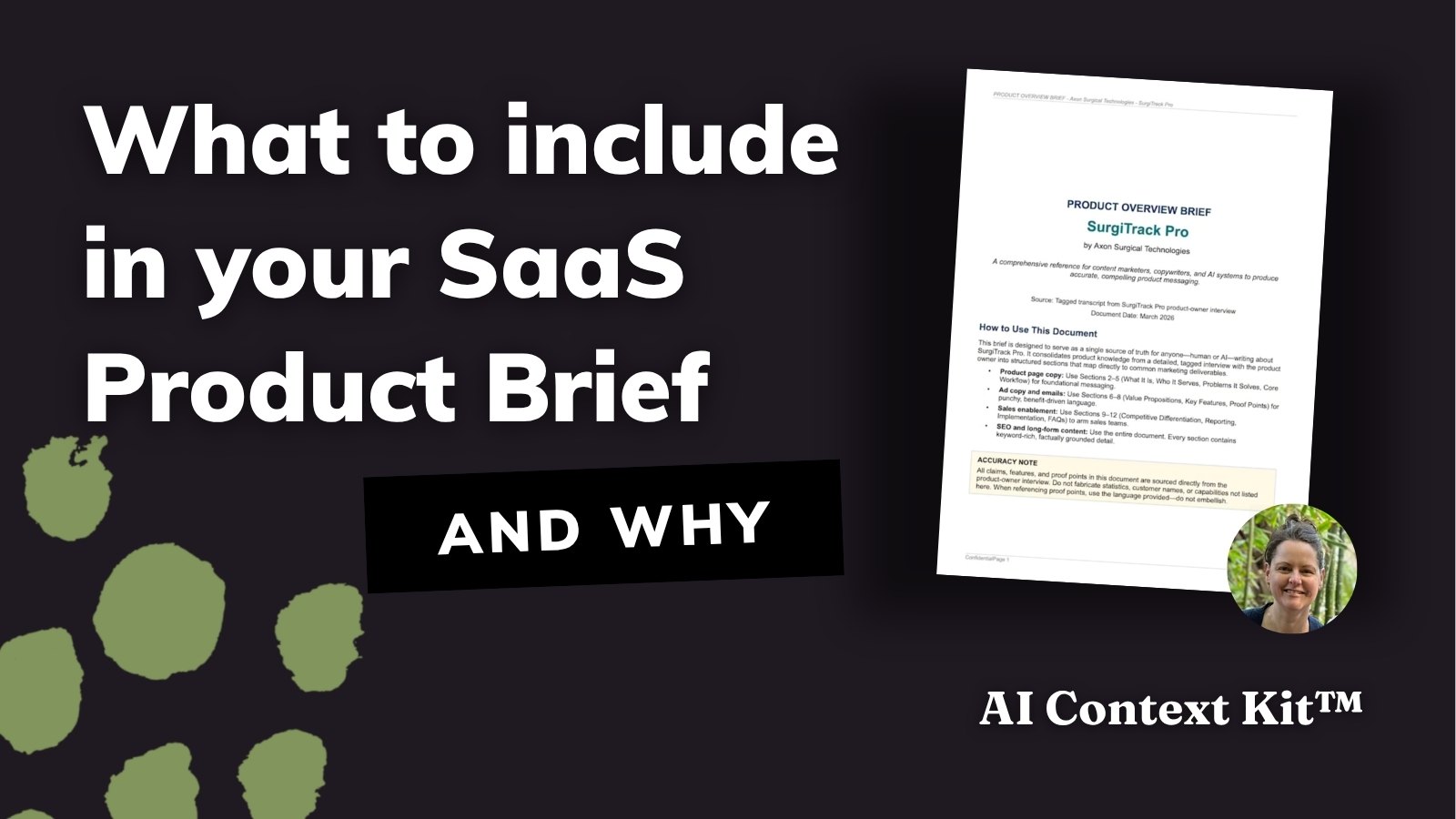
I was working with one client on optimizing their website for AI search. They needed product copy, landing pages, and content that actually answered questions buyers were asking. But one of their products barely had any documentation. So I scheduled a call with the product owner, ran a deep-dive interview, and turned it into a detailed product brief document.
That product brief went into Claude, along with persona profiles, the search strategy document we created, and a custom skill trained on best practices for AI search. With that context about the product and what good looked like, the landing page copy only took a couple hours to create. It was more thorough than anything they’d had on that product before, and the client had minimal edits.
→What “slow down to speed up” actually means with AI
This isn’t a new idea. But AI makes it more urgent, not less.
If you skip the foundation and just start generating, you’re not saving time. You’re producing output that still needs a full rewrite, or publishing things that technical buyers can see through in two sentences. Moving fast, producing noise, and damaging your brand.
Taking the time upfront to document what your product does, who your buyers are, what they care about, and what good looks like. That’s what makes AI useful. Not just faster. Better.
I’ve done this for my own business. Personas. Value by audience. What problems I solve, how I talk about them, the words my clients use when they describe their own situation. All of it is built into a project in Claude. When I want to write something new or work through an idea, I don’t start from scratch. I start from a foundation that already knows what I’m trying to say and who I’m saying it to and it’s so much faster.
→On agents (because everyone asks)
Dean asked me to explain AI agents in plain language.
Agents have agency. You give them a task and they go do it. Make decisions, take actions, produce an outcome. Without you prompting every step.
The easy example: a lead comes in through your website. The agent qualifies it against your ICP, researches the account, scores it, packages everything for your sales rep, and tells them when to follow up. You didn’t touch it.
A useful way to think about building toward that: most marketing teams are starting with what I’d call “teammates.” A very specific AI tool for a very specific task. Writing emails. Building a campaign brief. Each step in a workflow has its own focused tool. An agent is essentially chaining those together. So you’re not starting with full automation. You’re building the pieces, and eventually they connect.
But here’s the thing: According to the Microsoft 2026 Work Trend Index Annual Report released in May 2026, 16% of AI users are “Frontier Professionals” who actively build and orchestrate multi-agent systems. That’s only about four percent of the total population who are actually building agents right now. So if you haven’t gotten there yet, you’re not behind. With that said, there’s a real difference between waiting indefinitely (bad idea. You’re running out of runway for never touching AI) and being thoughtful about where to start (smart). The tools are getting easier every few months. Experiment and build, but don’t feel like you missed the window. At least not yet.
→Where to start
Dean pushed me on this: do you go after the biggest reward, the worst pain, or the easiest win?
My answer was a little of all three. You don’t want to take on so much that you get discouraged. But if you’re not solving a real pain, the thing won’t outlast the initial excitement of building it. Pick something small enough to actually ship, but meaningful enough that people will actually use it.
What I’ve seen over and over: the initial excitement of a cool AI build fades. What stays is the thing that makes someone’s day measurably easier.
For most B2B marketing teams I talk to, the real pain isn’t a lack of tools. It’s that the tools don’t have what they need to be useful. Product knowledge is locked in a founder’s head. There’s no documented positioning. Nobody has written down what different buyers actually care about. So you build on top of that gap, and the gap follows you into everything you produce.
That’s the thing to fix first. Not the workflow. Not the automation. The context. Everything else gets easier once that exists.
→If this resonates
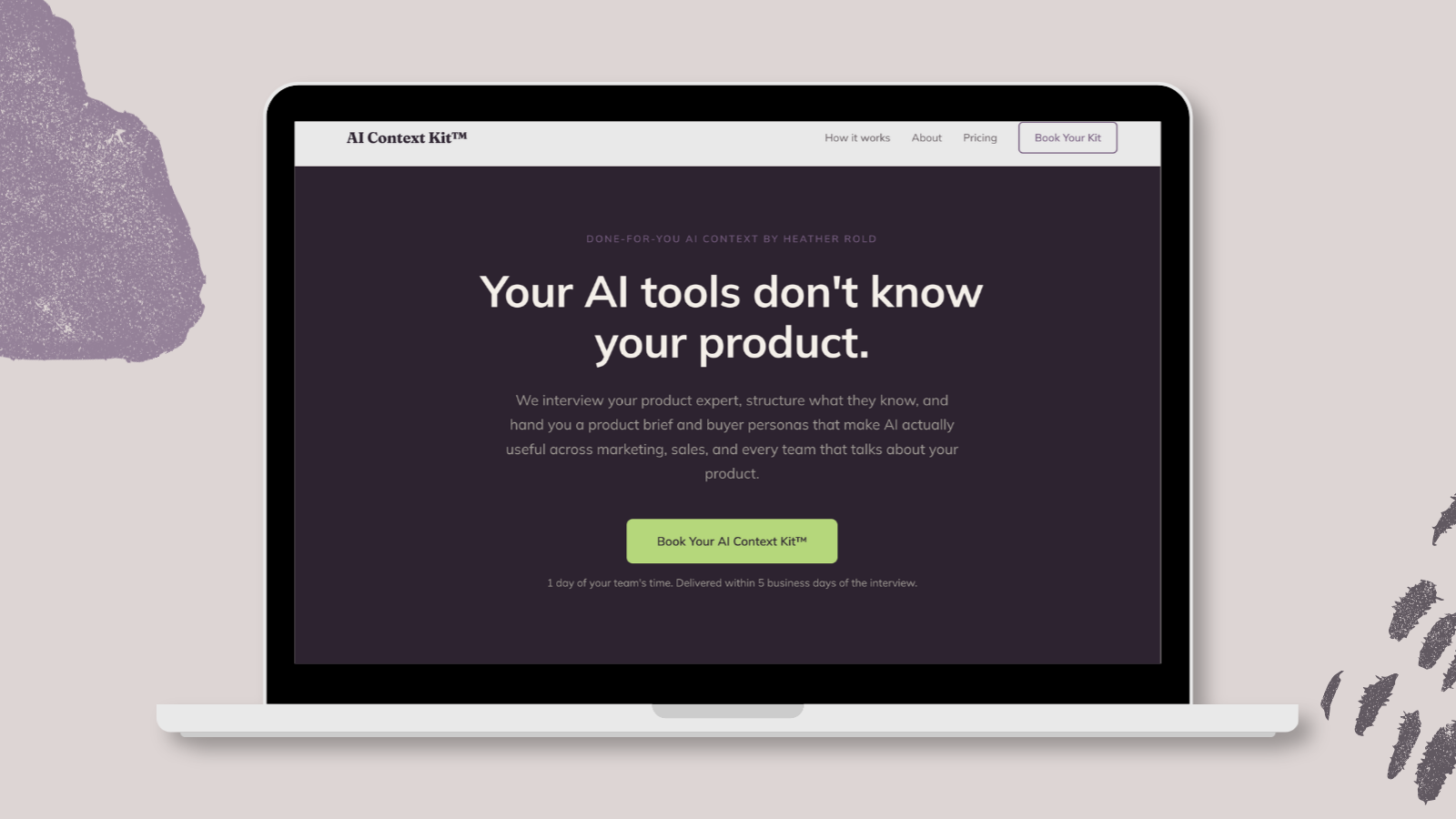
The process I described. One interview with your product expert, structured into documentation your whole team and your AI tools can work from. That’s what I’ve turned into a productized service called AI Context Kit™.
One interview. Five business days. You get a detailed product brief and persona profiles delivered as structured files you can load directly into Claude, ChatGPT, or whatever you’re using.
If any of this resonates with you, check out aicontextkit.com. I’m also easy to reach on LinkedIn if you want to talk through whether it’s the right fit.